History
“A castle estate with centuries of history”

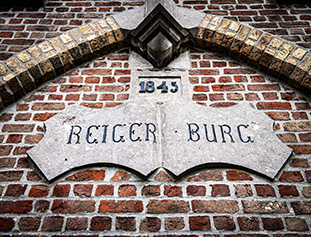
The Reiger Burg Estate has a rich history dating back to the Middle Ages. Over the centuries, the estate evolved from a medieval fiefdom to a 19th-century country house, a military site during World War I, and finally the castle as we know it today. In 1843, the Terrier family, nobles from northern France, had an elegant country house built there in an eclectic style, surrounded by an English-style landscape garden. Later, during the interwar period, the estate was further developed into the castle we see today.
Timeline
14th century | The true beginning of the estate
According to the Inventory of Immovable Heritage, the estate dates back to the 14th century. At that time, it was a fief of Gosuinus de Reghelsbrugge. The name Reghelburgh also appears later on the Ferraris Map. The double rampart that characterized the estate is consistent with its medieval origins. Inventory of Immovable Heritage
16th century | The Geuzen & the Siege of Ypres
An interesting additional historical note comes from a Ghent University study on Reigersburg: in the 16th century, the castle is said to have served as a stronghold for the Geuzen during the Spanish siege of Ypres.
1641–1834 | Various owners
According to the same study, Reigersburg changed hands several times during this period. Libstore
1845–1848 | The Terrier Family
In 1848, notary Jean-François Terrier (1770–1849) had reconstruction work carried out on the existing country house, which, among other things, doubled the size of the country estate.
1880 | Félicie Terrier
In 1880, Félicie Terrier, daughter of Louis Terrier, inherited the estate. She was married to Philippe Vandenberghe. Libstore
19th century | A true castle estate
On the military topographic map from 1861, the estate is clearly recognizable as a formally laid-out castle landscape: a double moat, a moated farmstead with a farmhouse, an access road from the Veurnseweg, and a formal garden/park layout. Later, the geometric character was softened with a large pond and winding paths. According to a historical source, there was even an ice cellar in the southwest corner of the outer moat. Inventory of Immovable Heritage
1914 | Reiger Burg in the midst of World War I
In October 1914, the castle was used as a base by the British Royal Field Artillery. The letters “R.F.A.” were found in the coach house, along with a red cross; the latter suggests that the building was also used as a medical post. Inventory of Immovable Heritage
1918 | The End of the Prewar Castle
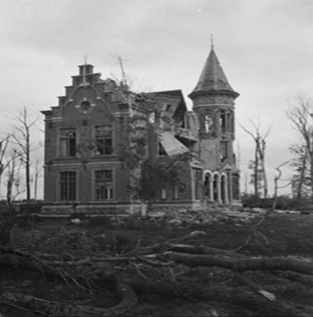
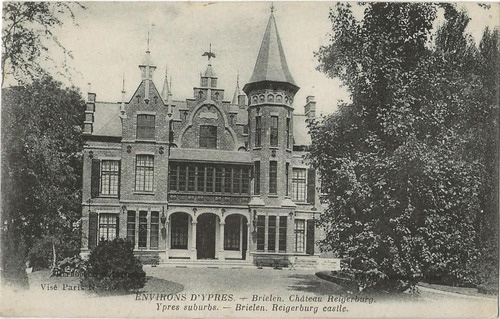
The pre-war Reiger Burg was destroyed during the war. That explains why the building we see today is actually a reconstructed castle.
1924 | The current Reiger Burg
Architect Raphaël Speybrouck of Ypres designed the reconstruction in 1924. It is noteworthy that he did not simply design a modern building: the new castle was reconstructed to match its pre-war appearance from 1845, partly using reused materials. This explains why the current building looks like a 19th-century Neo-Gothic castle, even though a large part of the existing structure actually dates from the interwar period. Inventory of Immovable Heritage



The Castle Today
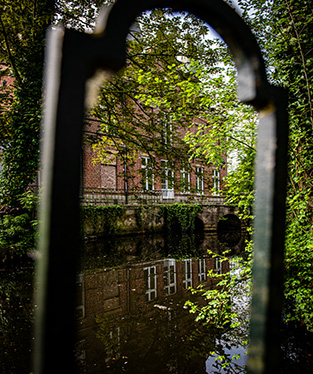
The current protected heritage site includes not only the castle but the entire estate, covering approximately 3.5 hectares: the castle, pond, ramparts, park, orchard, caretaker’s house, coach house, bridge, fencing, and dovecote.
The estate has been designated as architectural heritage since May 14, 2024. Inventory of Immovable Heritage
A particularly beautiful detail is that the medieval structure and the 19th- and 20th-century
layers literally lie on top of one another.


Press

Historical newspaper article
Just like De Drie Torren Castle, this castle (on Veurnesteenweg) also appeared on the British Army’s staff maps. From the adjacent stables, a British cannon barked with clockwork precision at the enemy positions a few kilometers away. The response was immediate, and what had once been a magnificent country estate was reduced to rubble.
Historical newspaper article
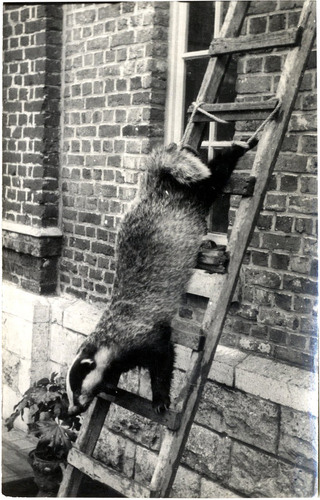
The Mouton brothers, who lived at Reigerburg Castle in Brielen, were driving at night between Ciney and Courrière (province of Namur). Suddenly, a herd of wild rabbits ran across the road, chased by a badger. The driver was unable to avoid the badger and hit it. Here we see the animal, which weighed between 35 and 40 kg.